Skill
How to Preserve a Family Recipe Beyond the Recipe Card
Ingredients and directions are only part of the knowledge. Preserve the person, cues, techniques, occasions, and evolution too.
- 6 pages
More tips
Pro tip
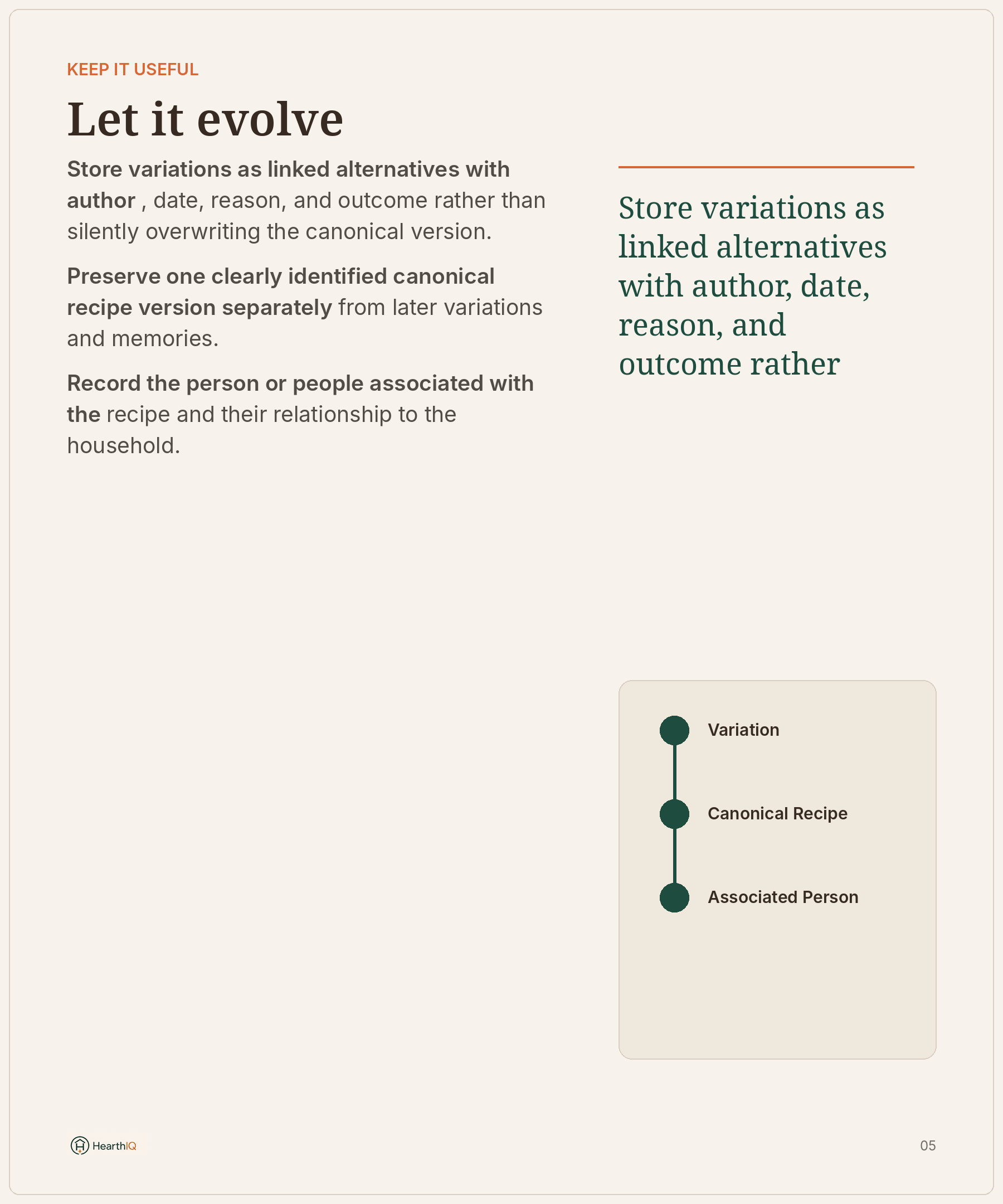
Preserve one clearly identified canonical recipe version separately from later variations and memories.
Pro tip
Record the person or people associated with the recipe and their relationship to the household.
Pro tip
Record when and why the recipe is served, including holidays, birthdays, Sunday dinners, or life-stage context.
Prep
Capture observable cues such as texture, aroma, color, sound, resistance, thickness, or visual doneness that are not expressed by time alone.
Pro tip
Record gestures, sequencing, pan choices, resting habits, and judgment calls that experienced family cooks may perform without mentioning.
Pro tip
Preserve a preferred brand or tool only when it materially changes flavor, texture, nostalgia, or execution—not as arbitrary clutter.
Pro tip
Record customary serving pieces, accompaniments, timing, table ritual, and presentation when they are part of the family meaning.
Pro tip
Photograph key ingredient states, technique moments, tools, and the final dish, not only posed portraits or finished plates.
Pro tip
Capture who loves, avoids, modifies, or remembers the dish and how those reactions have changed over time.
Pro tip
Store variations as linked alternatives with author, date, reason, and outcome rather than silently overwriting the canonical version.
Pro tip
Interview the cook during execution and ask what they are noticing before each important decision.
Pro tip
Do not invent origin stories, dates, or authorship when family memory is uncertain.
Pro tip
Record where the recipe came from, who adapted it, and which parts are known versus uncertain.