Shop Your House First · No. 02 of 20
How to Make Dinner From What You Already Have
Start with what needs using, not a recipe. Five parts, one rule and five dependable answers (fried rice, frittata, soup, casserole and sheet pan), with the quantities and times to make them tonight.
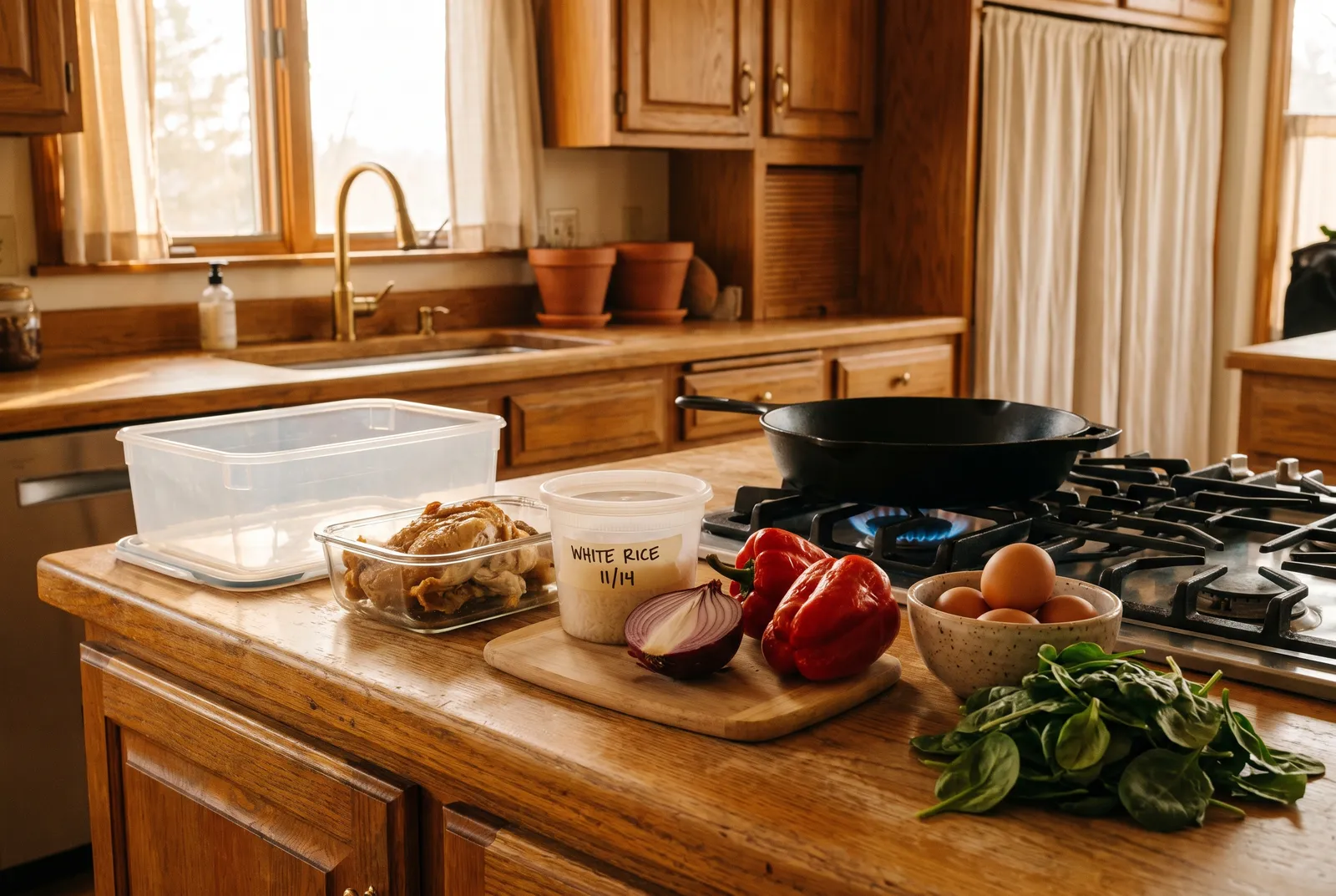
In No. 01 you made a Use first bin. Tonight, it earns its keep. Most of us plan dinner backwards. We pick a recipe, go buy everything it needs, and meanwhile the half bag of rice and the last of the roast chicken sit in the fridge, waiting for a turn that never comes. So let’s flip it. Start with what needs using, and a simple formula turns it into dinner.
Think of tonight as a choose-your-own-adventure, and the food that needs using is the adventure. The half bag of rice sends you one way, the soft vegetables another, the last few eggs somewhere else entirely. Follow where it leads, fill in the rest from what’s already in the house, season it the way your crew likes, and you land on dinner. We’ve mapped out five of the best paths, with real amounts and times, and there’s one rule for the whole trip: the food that needs using goes first, and it picks the dish.
1 · The formulaOne thing that needs using, plus four more.
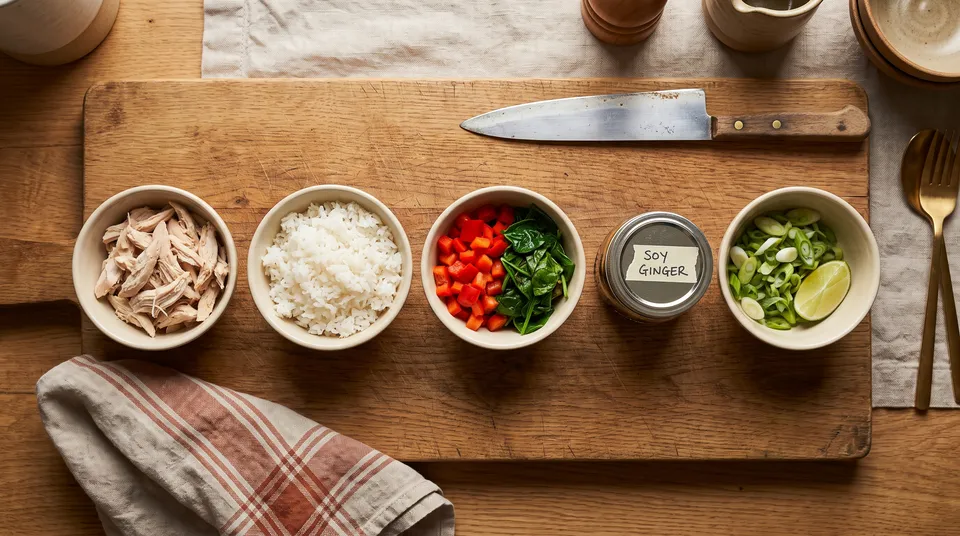
Every dinner here is built from the same five parts. Start with what needs using, then fill in the rest from what’s already in the house. And one food can pull double duty: in the soup below, beans can be the protein or the starch (the filling part, like potatoes, pasta or rice).
- A
What needs using — The leftover with the fewest days left. The soft vegetables, the half can, the last few eggs. It goes in first, and it decides what you’re making.
- B
A base — Rice, pasta, noodles, potatoes or eggs. Cooked rice and pasta from earlier in the week absolutely count.
- C
A vegetable — Fresh, frozen or canned, they all work. Those frozen bags in Zone E from No. 01 were made for this moment.
- D
A sauce or liquid — Broth, canned tomatoes, a white sauce (milk thickened with a little butter and flour), soy sauce, or beaten eggs. This is what holds everything together.
- E
Flavor and finish — Onion and garlic, dried or fresh herbs, a handful of cheese, buttered crumbs, a squeeze of lime.
“Start with what needs using. Let it choose the dish. Shop only for what’s missing.”
2 · Before you chooseFirst, see what needs using.
Step 1: Pull both Use first bins
Set the fridge bin and the freezer bin from No. 01 on the counter, plus anything open or going soft in the produce drawer. Congratulations: that’s tonight’s menu.
Step 2: Check each item’s clock
How long things keep in the fridge: cooked leftovers, 3 to 4 days; raw ground meat and raw poultry, 1 to 2 days; raw steaks, chops and roasts, 3 to 5 days; opened lunch meat, 3 to 5 days; fully cooked sausage, 1 week; hard-cooked eggs, 1 week; raw eggs in the shell, 3 to 5 weeks. Anything past its time goes out.
Step 3: Pick what goes first
Whatever has the fewest days left is tonight’s dinner. If it’s raw meat or poultry you can’t cook tonight, freeze it now instead: ground meat keeps its best quality for 3 to 4 months frozen, chicken pieces about 9 months.
Step 4: Fill in the rest, then list what’s missing
Go down the formula, A to E, checking the fridge, freezer and pantry. Whatever’s still missing goes on the list, and that’s all you shop for. Your grocery bill says thank you.
3 · The ruleLet what needs using pick the dish.
Here are five dinners you can count on. Match what needs using to one of them, then follow along.
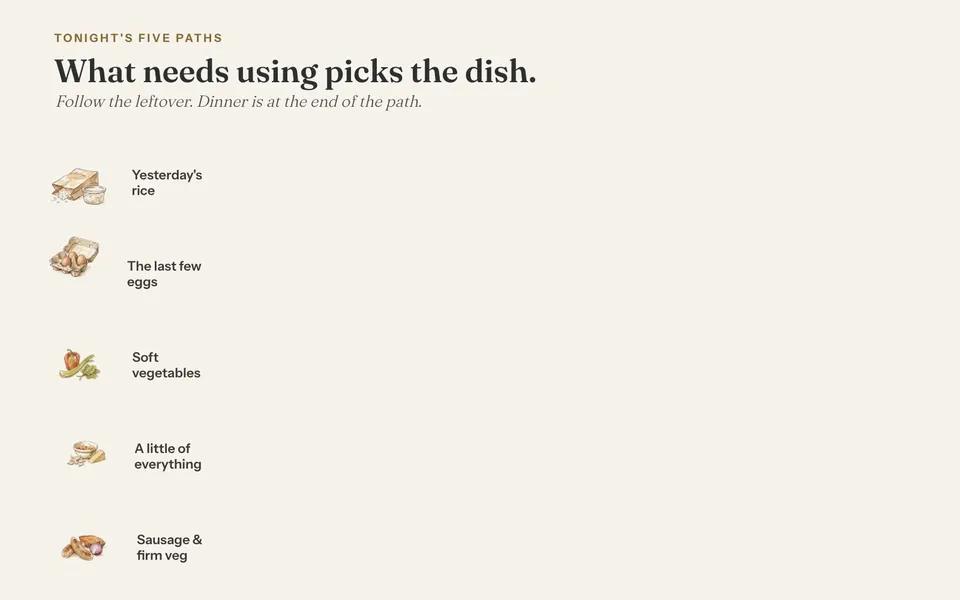
Answer 1 · 15 minutes prepFried rice: for the rice from Tuesday.
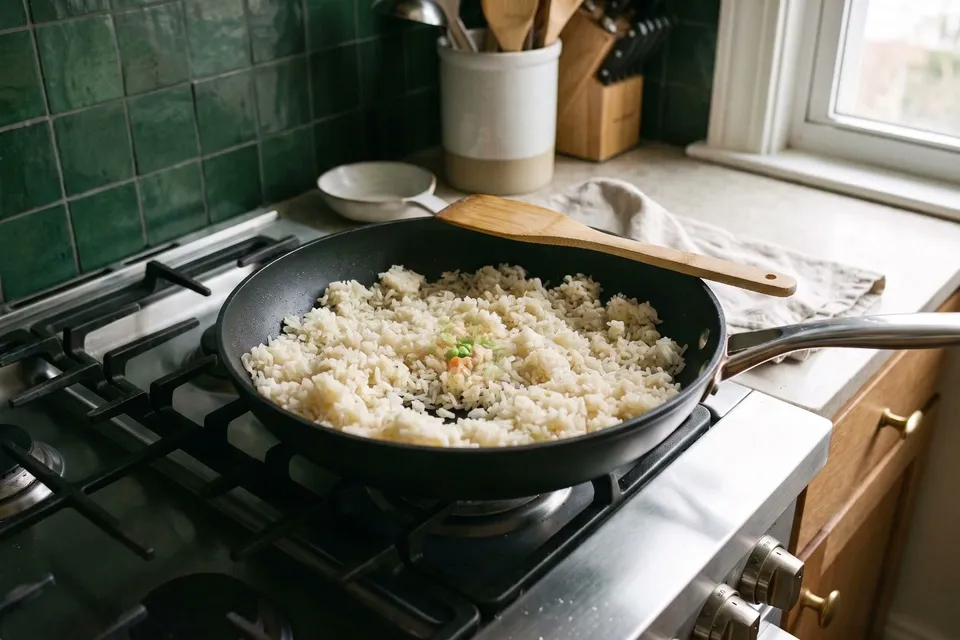
This makes 4 cups. You’ll need 2 cups cooled cooked rice (white or brown), 1 cup chopped onion, ¼ cup sliced or grated carrot, 1 cup chopped vegetables (fresh, frozen or leftover) and 1 teaspoon oil. For the protein, use ½ pound lean pork, or swap in 1 cup cooked or canned meat, which is how the leftovers sneak in. For the sauce, mix 2 tablespoons low-sodium soy sauce, ½ teaspoon garlic powder (or 2 cloves, minced) and 1 teaspoon black pepper. And here’s the best news in this whole guide: cold leftover rice makes a better texture than freshly cooked warm rice. Day-old rice, finally getting the respect it deserves.
Step 1: Mix the sauce
Stir the soy sauce, garlic and pepper together in a small dish and set it aside.
Step 2: Brown raw protein, if any
In a large skillet over medium-high heat, sauté the raw pork in the oil (cook it fast, stirring often) until it’s lightly browned. Already-cooked leftover meat skips this step and goes in with the vegetables.
Step 3: Add the vegetables
Add the carrot, onion and chosen vegetables, and sauté until tender, stirring often.
Step 4: Add the rice
Stir in the rice and the sauce, breaking up the clumps, and keep stirring until it’s hot all the way through. Leftover meat should reach 165°F.
Shop this
Answer 2 · about 25 minutesFrittata: for the last 2 cups of anything.
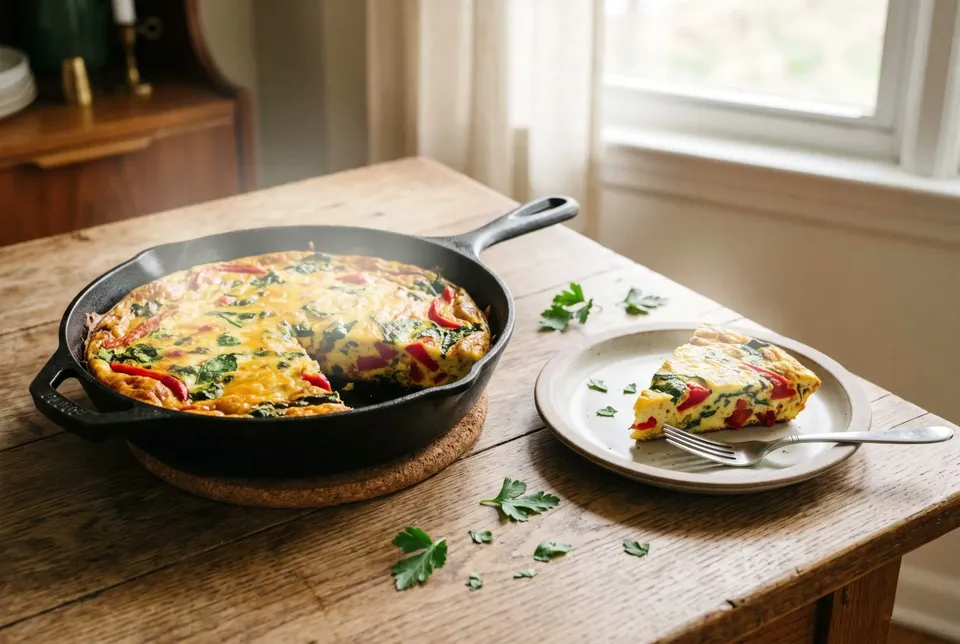
A frittata is a thick, open-faced omelet that sets gently in the pan, and it’s the best friend a half-empty produce drawer ever had. You’ll need 9 large eggs, 2 cups diced vegetables, ¼ cup chopped onion, 2 garlic cloves, 1 teaspoon thyme, ½ tablespoon dried oregano, ½ teaspoon salt, ¼ teaspoon pepper, ½ cup shredded cheese (any type) and 1 tablespoon olive oil. It happily takes the soft pepper, the last of the spinach and that lonely cheese end from the Use first bin.
Step 1: Cook the vegetables down · about 10 min
Heat the oil in a large skillet. Add the vegetables, onion, garlic, herbs, salt and pepper, and cook until the vegetables are tender and their liquid has cooked off.
Step 2: Whisk the eggs
Whisk the eggs in a bowl and stir in the cheese.
Step 3: Cover and set · 15 min
Pour the eggs over the vegetables and stir gently. Cover, turn the heat down, and cook until the center is set, or until a thermometer in the eggs reads 160°F.
Answer 3 · 25 to 35 minutes of simmeringSoup: for the soft vegetables and half cans.
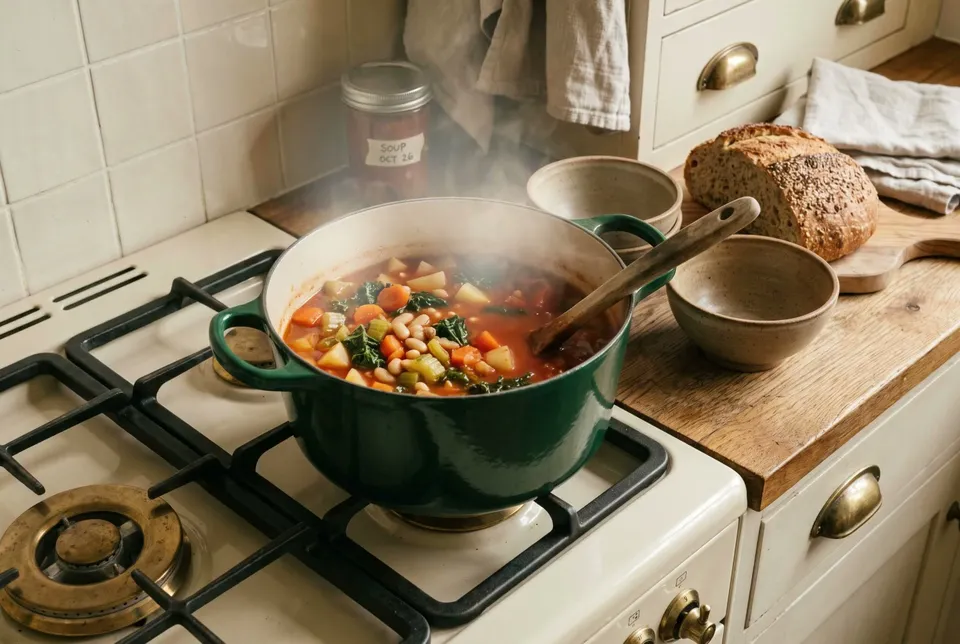
This soup serves 4 adults and takes 2 to 3 cups of almost any vegetable, fresh, canned or frozen. It’s very forgiving. Even the bendy celery is welcome here.
Step 1: Start the onion
In a large pot, cook 1 medium onion, chopped, in ¼ cup water or broth until it’s slightly browned.
Step 2: Add vegetables and protein
Add 2 to 3 cups chopped vegetables and one protein: one 16-oz can of beans, 1 pound meat (brown it as needed), one 16-oz can of meat, or 1 cup grated cheese.
Step 3: Add a starch and 1 quart of liquid
Starch: 3 to 4 cups diced potatoes, 4 oz pasta or noodles, or ½ cup uncooked brown rice. Liquid, 4 cups total: two 16-oz cans of broth; 4 cups water with bouillon (stock cubes or powder); a can of crushed or diced tomatoes plus 2 to 3 cups water; or 4 cups milk with bouillon. Add 2 to 3 teaspoons dried herbs or a bay leaf.
Step 4: Simmer · 20 to 30 min
Partly cover and simmer (gentle bubbles, not a hard boil) until the meat is cooked through and the starch and vegetables are tender. Adding already-cooked leftover meat? Stir it in here, and bring the soup to a rolling boil to reheat it.
Step 5: Finish · 5 min
Add 2 to 4+ tablespoons fresh herbs, season with salt and pepper, and simmer 5 minutes more.
Answer 4 · about 1 hour in the ovenCasserole: for small amounts of several things.
A casserole is made for exactly this: little bits of leftovers turned into one dish that makes 6 servings. Pick one from each line below, mix them in a greased 2- to 2½-quart casserole dish, cover it, and bake. It’s basically cleaning out the fridge, and somehow everybody still asks for seconds.
Starch: choose one
2 cups uncooked pasta, cooked · 1 cup uncooked long-grain white or brown rice, cooked · 4 cups uncooked noodles, cooked.
Protein: choose one
2 cups cooked ground beef · 2 cups cooked, diced chicken, turkey, ham, beef or pork · 2 cups chopped hard-cooked egg · two 6- to 8-oz cans of fish or seafood, flaked · 2 cups cooked or canned dry beans.
Vegetable: choose one
One 10-oz package frozen spinach, broccoli, green beans or peas, thawed and drained · one 16-oz can green beans, peas, carrots or corn, drained · 2 cups sliced fresh zucchini.
Sauce: choose one
2 cups white sauce, or a can of sauce-type soup mixed with milk to make 2 cups · one 16-oz can diced tomatoes with juice.
Flavor: one or more
½ cup chopped celery, ¼ cup chopped onion, ¼ cup sliced black olives · 1 to 2 teaspoons mixed dried herbs · salt and pepper.
Bake, then top
Covered at 350°F for about 50 minutes to 1 hour, or microwave at 50% power for 15 to 30 minutes, until steaming hot (165°F) throughout. Then add 2 tablespoons Parmesan, ¼ cup shredded cheese or ¼ cup buttered crumbs, and return it uncovered: about 10 minutes in the oven or about 2 minutes in the microwave.
Answer 5 · about 15 minutes in the ovenSheet pan: for firm vegetables and cooked sausage.
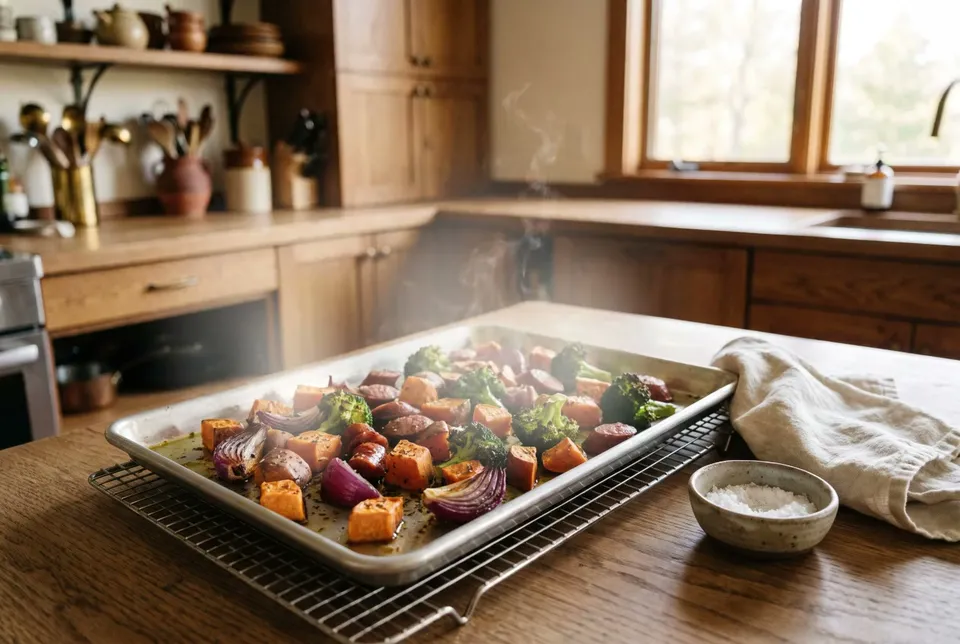
Step 1: Heat the oven to 425°F
Plan on 1 cup of vegetables per person.
Step 2: Cut to match
Cut the vegetables into similar-size pieces. Pieces about ½ inch thick brown more and cook faster; long thin ones like asparagus or green beans can stay whole.
Step 3: Oil lightly, spread out
Toss with just enough oil to make them shine (1 teaspoon per cup), then spread them out in a single layer. Give them a little elbow room.
Step 4: Roast and turn · 5 to 15 min
Thin pieces may take about 5 minutes; ½-inch pieces about 15. Stir or turn them halfway. And if you’ve got a pan without sides, use it: it browns more.
Step 5: Warm the leftover protein
Add already-cooked meat, like fully cooked sausage or leftover chicken, to the pan to heat through. Reheated leftovers should reach 165°F.
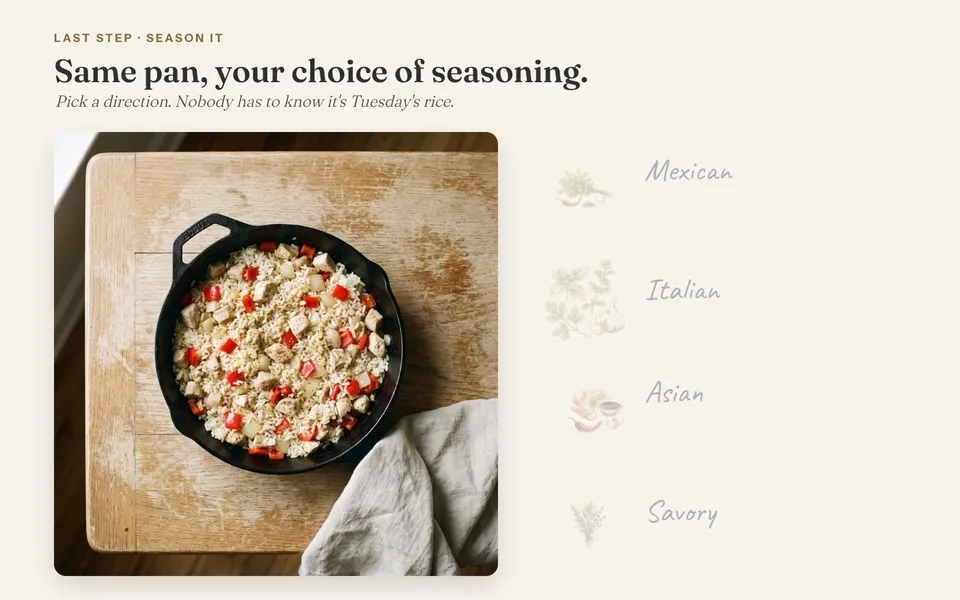
Last step · Season itThen season it your way.
You picked the food that needs using, it picked the dish, and now comes the fun part. Change the herbs and spices, and the same pan tastes like a whole different dinner. Nobody at the table has to know it’s Tuesday’s rice.
4 · Missing one thing?Swap before you shop.
Missing one part of the formula? Check for a swap before you grab your keys.
5 · After dinnerTonight’s leftovers are tomorrow’s first pick.
Step 1: Into the fridge within 2 hours
Refrigerate leftovers within 2 hours of cooking, or within 1 hour if it’s above 90°F. Split big batches, like a pot of soup, into shallow containers so they cool quickly.
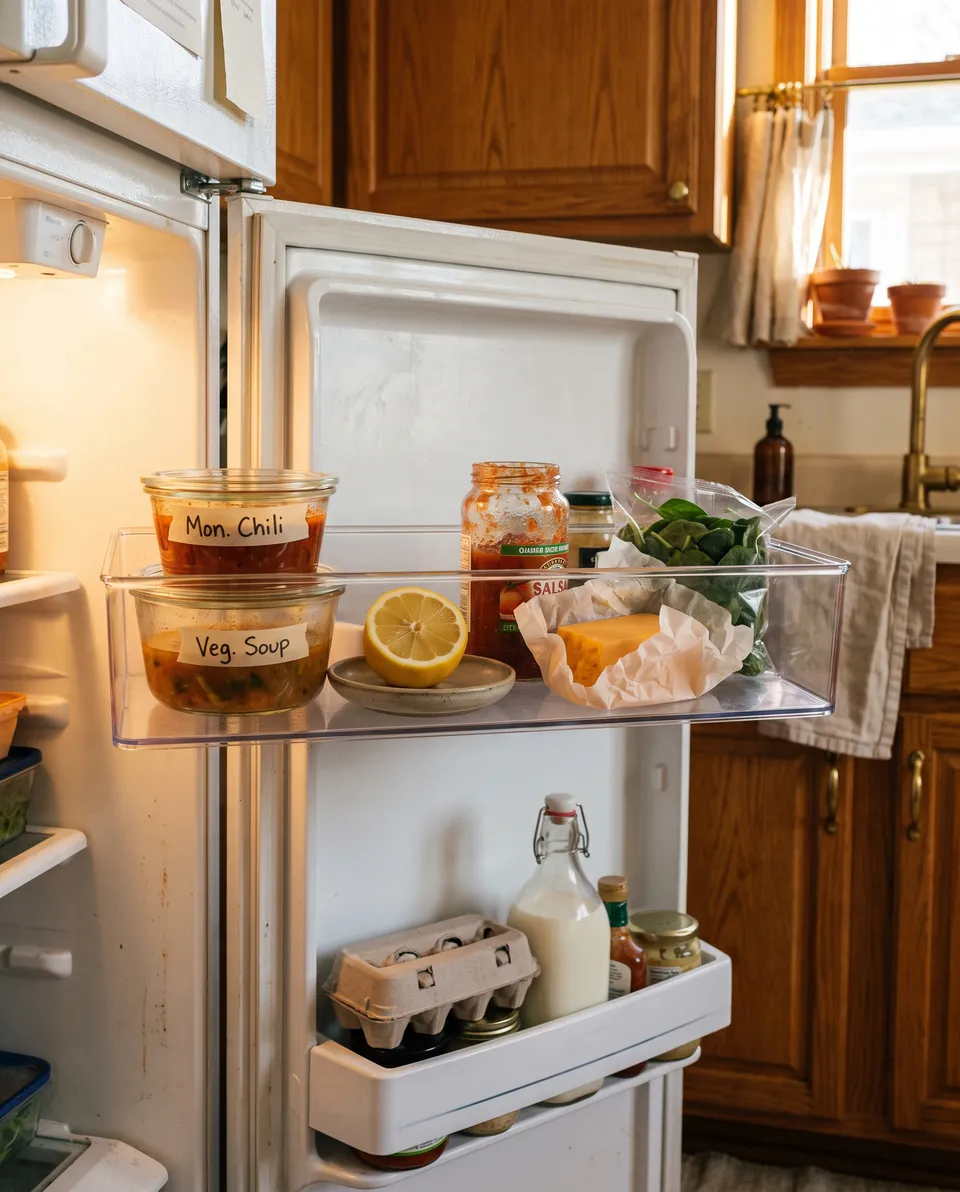
Step 2: Seal, name and date it
Cover leftovers or seal them airtight, then write the name and date on masking tape. That’s what lets next-week you trust the 3-to-4-day clock.
Step 3: Into the Use first bin, or the freezer
Leftovers keep 3 to 4 days in the fridge. Anything you won’t eat by then goes in the freezer, where it keeps its best quality for 3 to 4 months.
Step 4: Reheat to 165°F
Bring sauces, soups and gravies to a rolling boil. Cover other leftovers while they reheat. Microwaves heat unevenly, so check the temperature in several places.
Shop this
- iDesign Linus clear binsThe same bins as No. 01; one becomes the fridge’s Use first binamazon.com
- Masking tape and a permanent marker (search link)Name and date on every leftoveramazon.com
- ThermoWorks ThermoPop 2America’s Test Kitchen Best Buy, instant-read thermometersthermoworks.com
- ThermoWorks Thermapen ONEAmerica’s Test Kitchen winner, instant-read thermometersthermoworks.com
Quick referencePin this.
Sources: USDA FSIS, Leftovers and Food Safety · FoodSafety.gov, Cold Food Storage Chart · Nebraska Extension, Making a Casserole from What’s on Hand · Utah State Extension, Create a Soup and Create Family Meals · Food Hero, Oregon State Extension: Fried Rice and Roasted Vegetables · University of Illinois Extension, Recipe Substitutions · America’s Test Kitchen reviews of nonstick skillets, rimmed baking sheets and instant-read thermometers. Checked October 4, 2026. HearthIQ may earn a commission on product links.