Shop Your House First · No. 03 of 20
Organize Your Pantry for Visibility, Not Perfection.
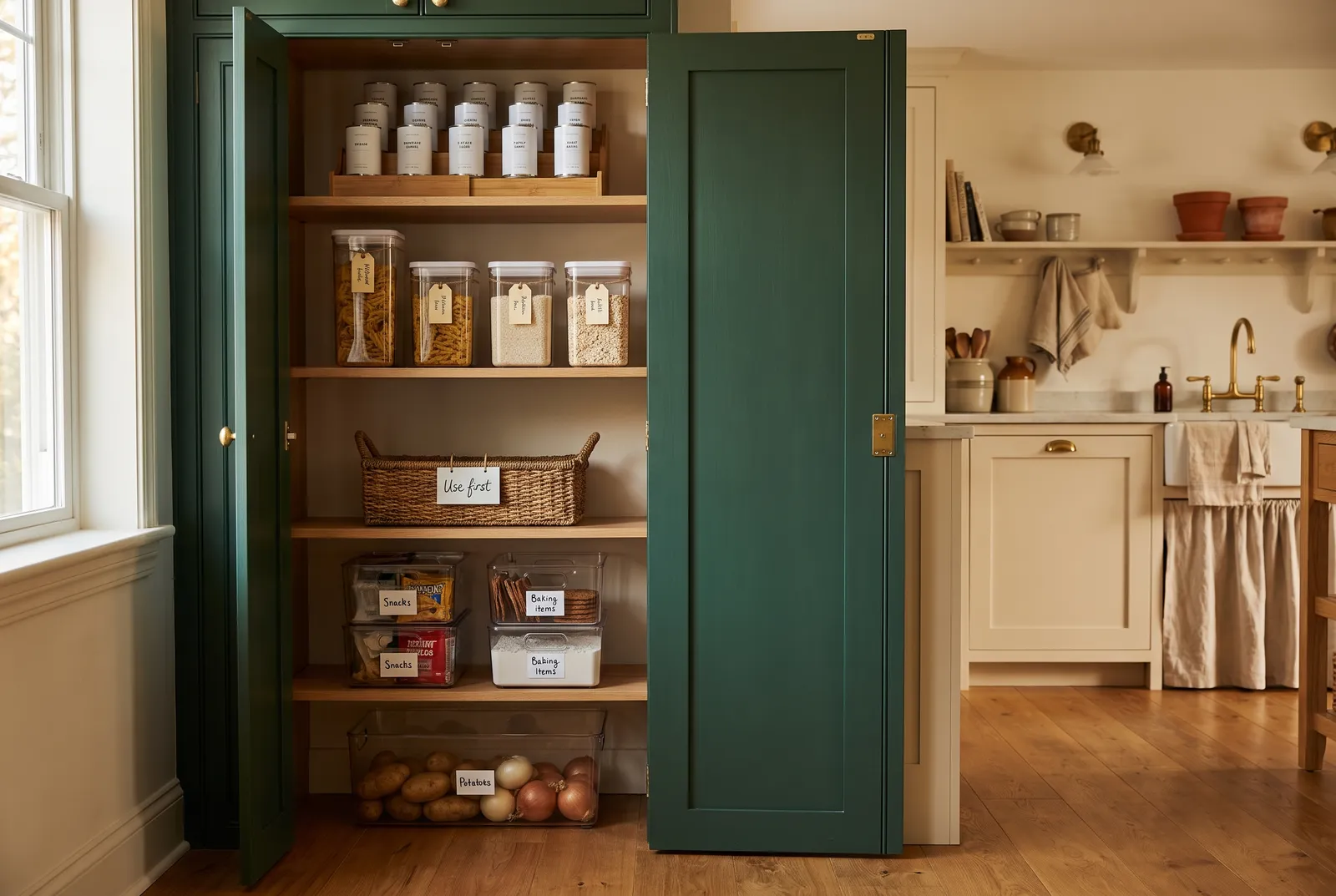
If you can’t see it, you’ll buy it twice. The same five zones and two labels as your freezer, applied to the pantry you actually have — deep cupboard, shallow shelves, closet, or no pantry at all.
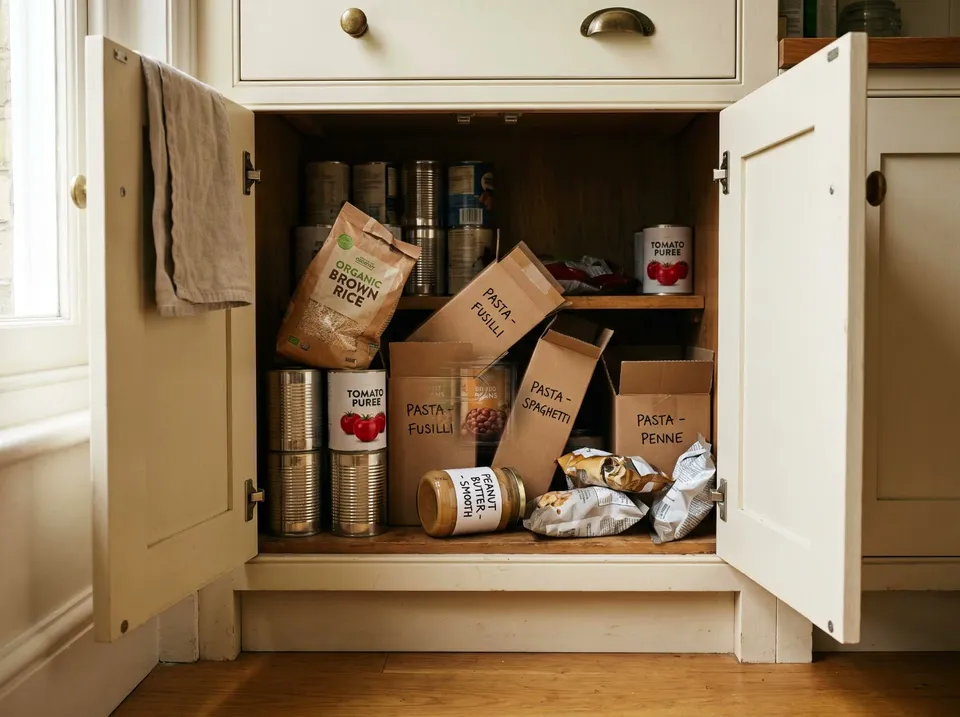
Every pantry has a back row. It’s where the second jar of peanut butter lives, right behind the can of tomatoes you bought because you couldn’t see the first one. You don’t need a prettier pantry. You need one you can read in five seconds from the doorway, so you shop it before you shop the store.
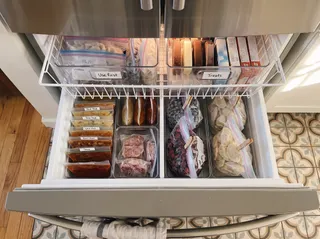
If you set up your freezer with No. 01, good news: you already know how this works. Same five zones, same two kinds of labels, just on a shelf this time. In No. 02 you made dinner from what you already have. This is how you actually see what you have. Give it one afternoon, once, and then five minutes on a Sunday.
The one ruleIf you can’t see it, you’ll buy it twice.
Being able to see everything beats having it look perfect. One row deep where you can, labels facing out, oldest in front. A pantry that looks tidy but hides the back row still sends you to the store for something you own. A pantry that looks a little busy but shows you everything sends you to the store with a shorter list.
1 · The same five zonesYour freezer’s zones, on a shelf.
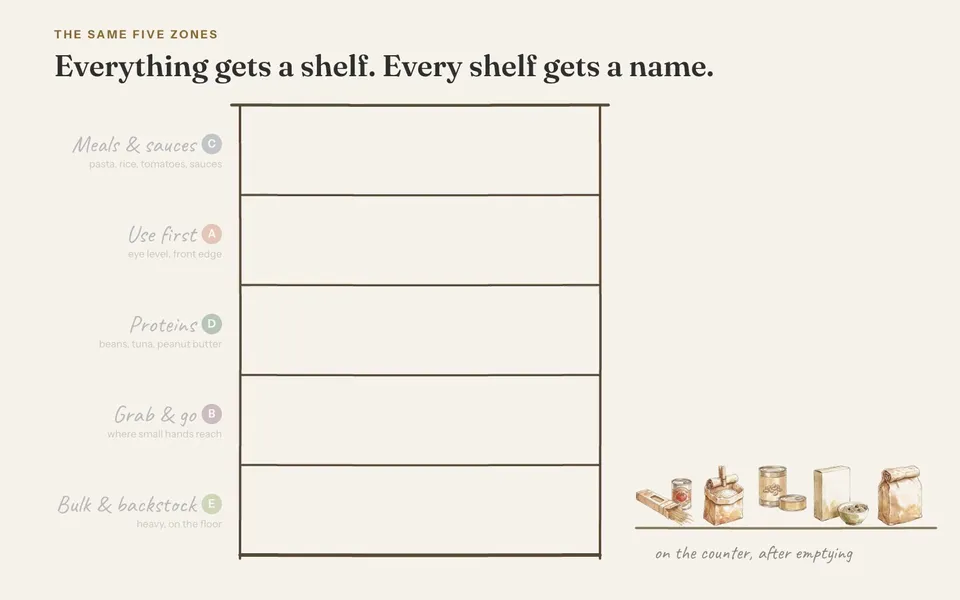
Give the pantry the same five zones as the freezer, so the whole house speaks one language. Use first goes at eye level, the heavy stuff goes low, and the snacks go wherever the people who eat them can reach. (Yes, that means the little ones can reach the snacks. Choose your battles.)
- A
Use first — Opened bags and boxes, the half jar of salsa, anything getting close to its date. Tonight’s first option.
- B
Grab & go — Snacks, cereal and breakfast, all in one bin and out of dinner’s way.
- C
Meals & sauces — What dinner gets built from: pasta, rice, canned tomatoes, broth and jarred sauces.
- D
Proteins — Canned beans, tuna and chicken, dried lentils, peanut butter.
- E
Bulk & backstock — The unopened extras and big bags, on the top or bottom shelf. You shop here when the front runs out.
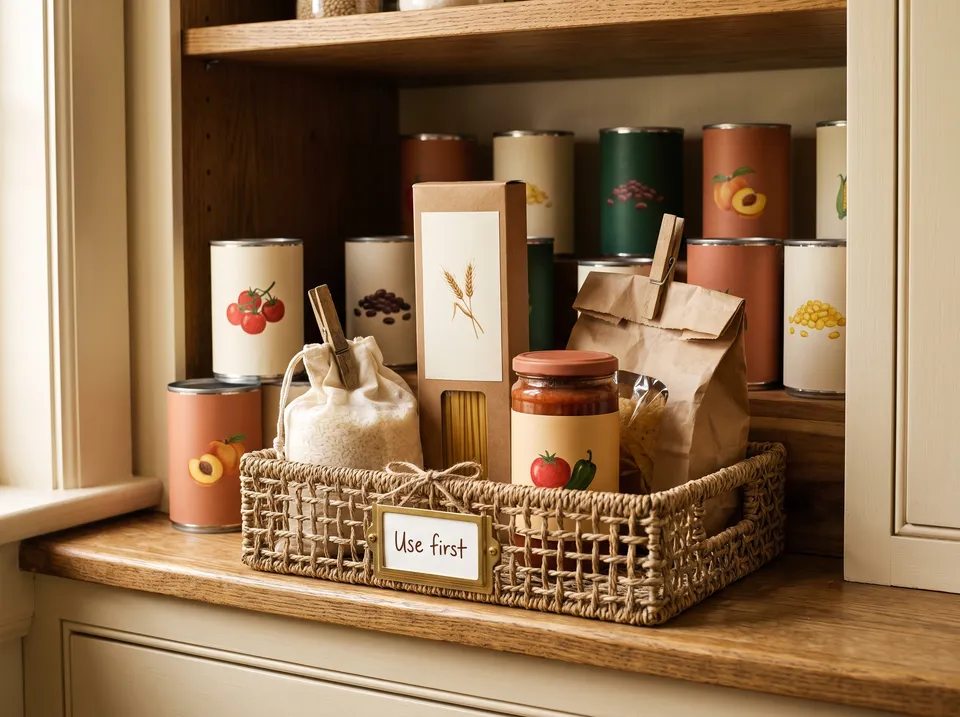
“If it’s in the Use first basket, it’s tonight’s first option.”
2 · The big resetEmpty it once, properly.
Do this the day before a grocery run, when the shelves are at their emptiest. Work one shelf at a time on a cleared counter, so you don’t end up sitting on the kitchen floor surrounded by cans, wondering how you got here.
Step 1: Measure · 10 min
Width, depth and height of each shelf, plus how far the door lets you in. Do this before you buy a single bin. It’s the step everyone skips and then regrets.
Step 2: Empty one shelf · 10 min
Onto the counter, grouping like with like as you go. The duplicates will jump out at you first. (Three jars of cinnamon. It happens to the best of us.)
Step 3: Check every can · 10 min
Set aside anything bulging, leaking, badly rusted or deeply dented. What to toss is in the box below.
Step 4: Look for bugs · 5 min
Holes in bags, webby clumps in flour or grains, small moths. Throw out anything with bugs in it. If you only suspect them, freeze that food at 0°F for at least four days. Then vacuum the shelf, especially the cracks and corners.
Step 5: Sort into zones · 15 min
Opened things go to Use first. The second and third of anything go to Bulk & backstock. Everything else goes to its zone.
Step 6: Put it back, labels out · 20 min
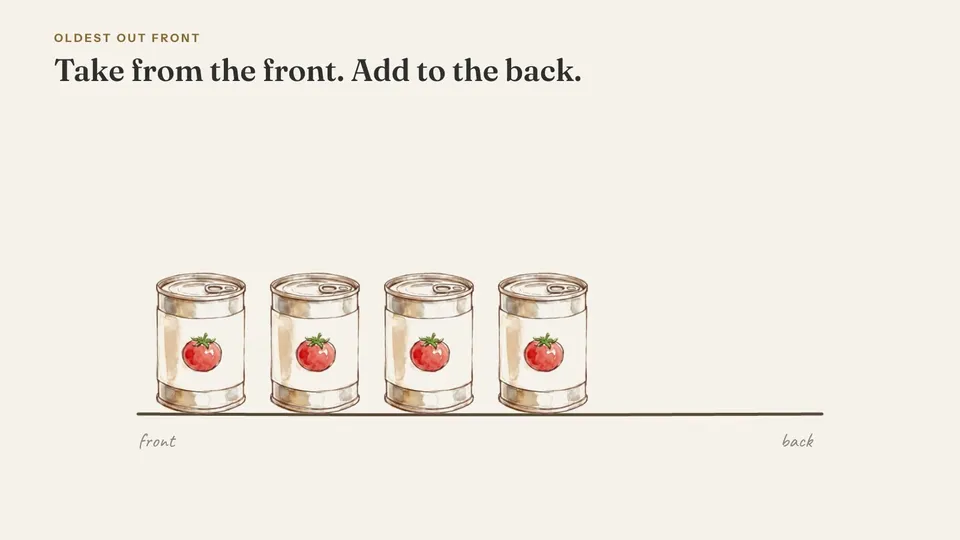
One row deep where you can. Oldest in front, newest behind. Every label turned to face you.
Step 7: Write down the backstock · 5 min
A short list on the inside of the door, or in HearthIQ, so your next grocery list starts from what you already have.
3 · Your pantry, your layoutFour pantries, one system.
The zones never change. How you make them easy to see depends on the shelves you’ve got.
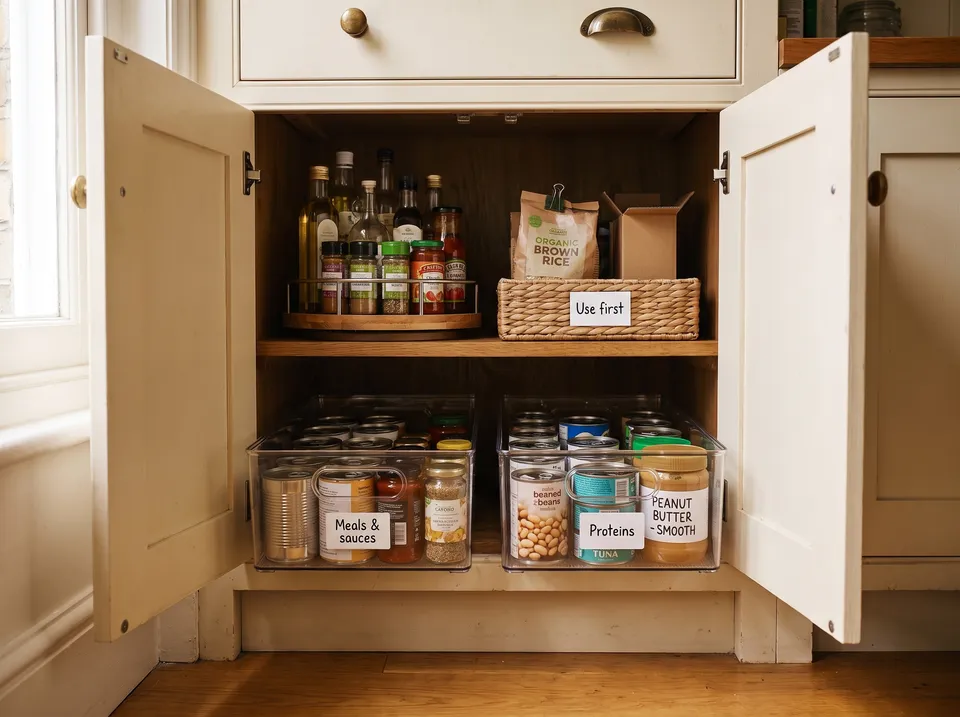
Deep cupboard
Nothing sits two deep unless it’s in a bin. Use one handled bin per zone with the label on the front edge, and pull the whole bin out to see the back. Put a turntable (a lazy Susan) in the back corner for oils and vinegars, which otherwise vanish back there forever.
UseiDesign Linus deep bin with handles · Copco 12-in 2-tier turntable
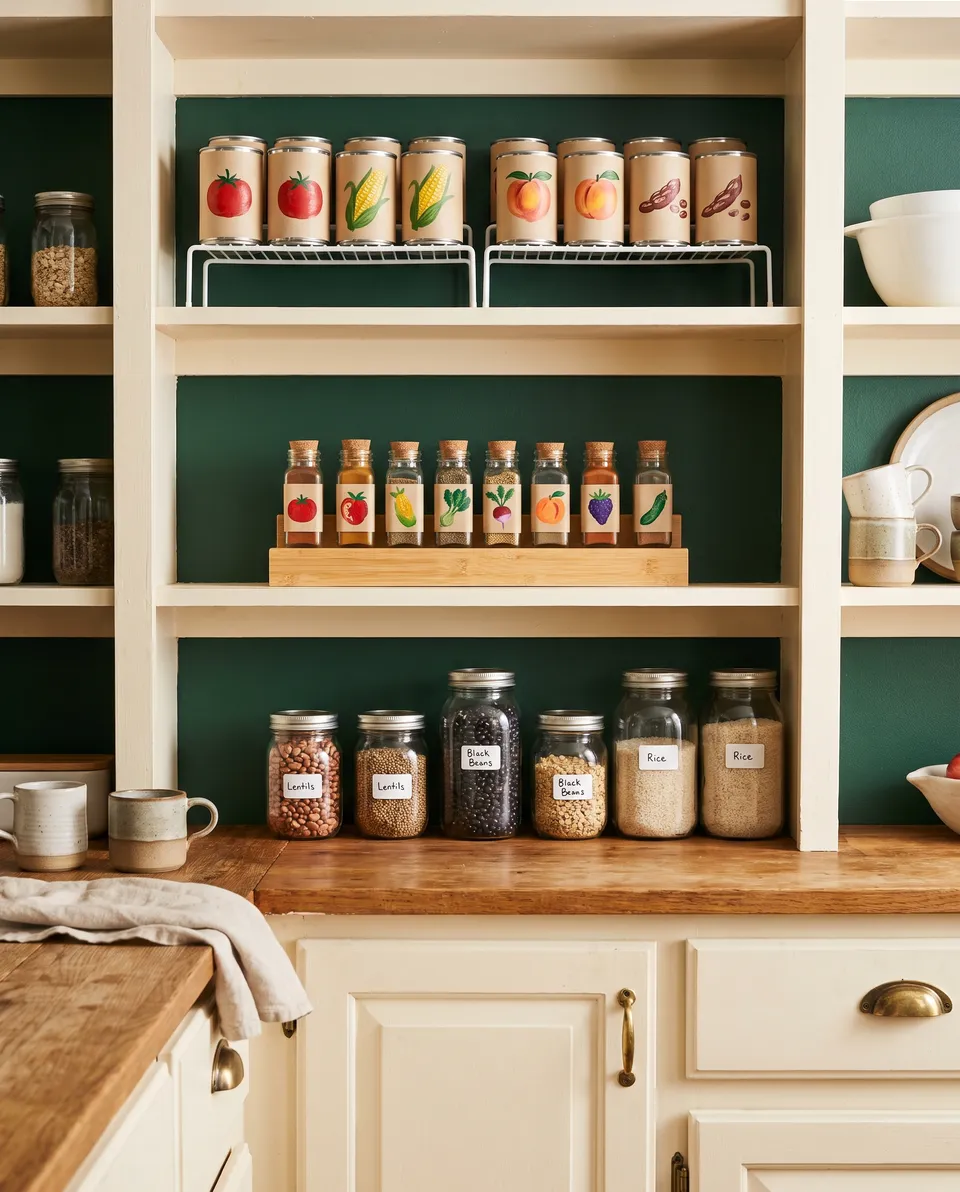
Shallow shelves
The easiest pantry to read. Keep it one row deep, and set the back of each row on a step riser (a little stair for cans) so the second line stays visible. Group each zone into a short line, labels out.
UsemDesign 3-tier expandable rack · Expandable 3-tier can riser (Amazon search link)
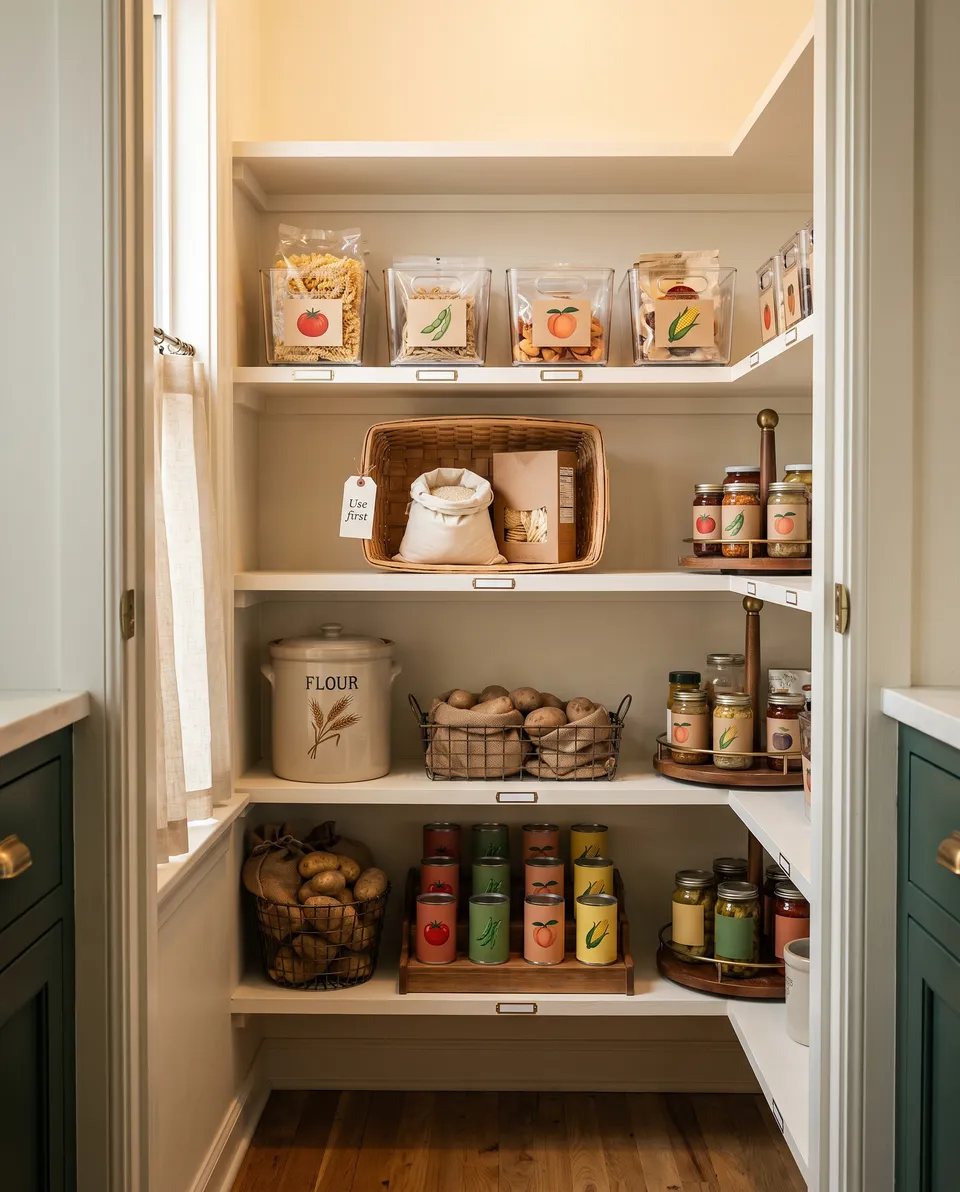
Closet or walk-in pantry
Sort by height. Use first and Meals & sauces at eye level, Grab & go at the height of whoever does the grabbing, Bulk & backstock on the top shelf and the floor. Turntables earn their keep in those dead corners where two shelves meet.
UseiDesign Linus clear bins · Cambro CamSquares 6-qt container · Copco 12-in 2-tier turntable
Shop this
- IKEA RÅSKOG utility cartThree tiers on casters; IKEA lists it as 11x15x24ikea.com
- Home-Complete over-the-door rackHolds far more than spice jars · America’s Test Kitchen best over-the-door optionamazon.com
- Expandable 3-tier can riser (Amazon search link)No reviewer pick exists; measure shelf width and depth firstamazon.com
4 · What goes in whatPour out only what needs protecting.
You don’t have to pour everything into matching jars. A can or a sealed jar is already the best container it’s ever going to have. Move the things that come in paper and thin plastic, because a container with a tight lid keeps out damp air and bugs far better than a bag or a box. Tightly closed glass, metal or heavy plastic all work.
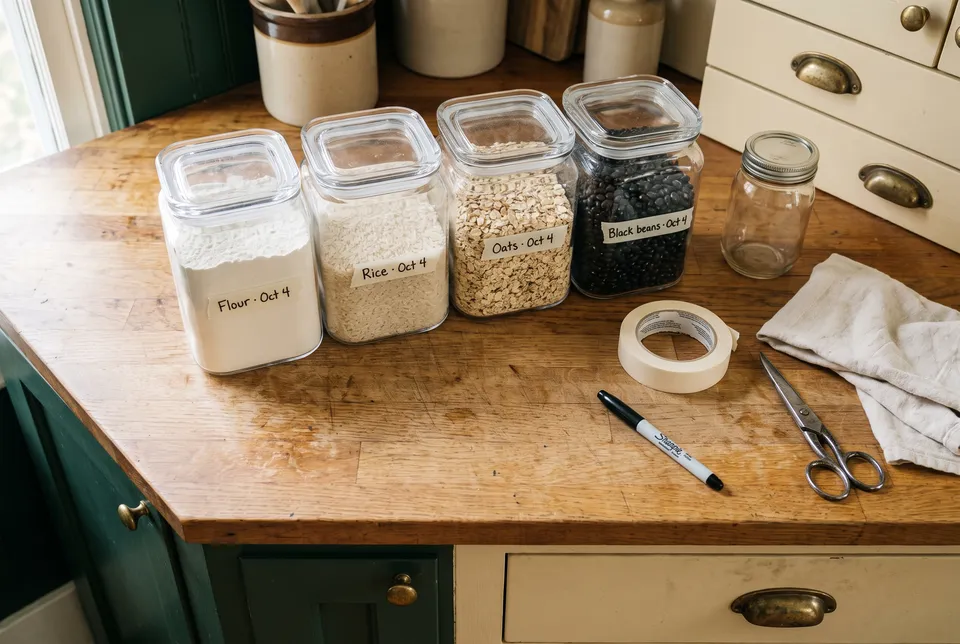
Flour and sugar
A 6-quart container holds a 5-lb bag of flour with room left to dip and level a measuring cup, and 3 quarts fits a 4-lb bag of sugar. Whole-wheat flour is different: its natural oils go stale and bitter at room temperature, so it lives in the fridge all year.
UseCambro CamSquares 6-qt container · Progressive ProKeeper+ 4-qt flour container
Rice, oats and pasta
2 quarts fits a 2-lb bag of rice or a 2.6-lb package of oats, and 1 quart fits a 1-lb bag of rice or a 24-oz box of cereal. White rice and dried pasta keep about 2 years on the shelf.
Canned goods
Leave them in the can. High-acid cans (tomatoes, fruit, pickles) are at their best for 12–18 months; low-acid cans (beans, soups, vegetables, meat) for 2–5 years. Once a can is open, move what’s left into a glass or plastic container in the fridge: 3–4 days for low-acid, 5–7 days for high-acid.
Opened snacks, cereal and crackers
Squeeze out the air, roll the bag down, clip it, and stand it up in the Grab & go bin so you can see every bag.
Spices
Keep them away from the stove, in airtight containers, out of sunlight and heat. Give ground spices and dried herbs the sniff test after six months: if they don’t smell like much, they won’t taste like much either.
Oils, nuts and whole grains
Vegetable oil keeps 6–12 months unopened and 1–6 months opened, somewhere cool and dark. Nut and sesame oils don’t last as long, and neither do whole-wheat flour and nuts, which belong in the fridge or freezer.
5 · Labels that do the talkingThe same two labels as the freezer.
Shop this
6 · Keeping it workingFive minutes on Sunday, again.
Same five minutes as the freezer, same order. Open Use first and plan one or two of this week’s dinners from it before you write a grocery list (that’s No. 02 doing its job). Check Bulk & backstock: if it’s there, it isn’t on the list. New groceries go in behind what you already have, so the oldest always gets used first. Every few weeks, cook from the cans that have been hanging around a while. And buy dried foods in amounts you’ll finish in two to four months. It’s also your best protection against pantry moths.
Quick referencePin this.
Sources: USDA FSIS, Shelf-Stable Food Safety (updated Oct 24, 2024) and Food Product Dating (updated Apr 23, 2025) · Clemson Cooperative Extension, Safe Handling of Canned Goods (2024) · Penn State Extension, Storing Staple Ingredients in the Kitchen (2024) · University of Minnesota Extension, Pantry Pests (reviewed 2024) · America’s Test Kitchen, Dry Storage Containers (2026) and Spice Storage Solutions (2025). Checked October 4, 2026. HearthIQ may earn a commission on product links.