Shop Your House First · No. 06 of 20
Leftovers Are Ingredients: How to Turn Yesterday Into Tonight
Every leftover leaves the table with two things: a next use and a deadline. Seven chains that turn yesterday’s chicken, rice, pasta, bread, beans and bones into tonight, with how long each one keeps.
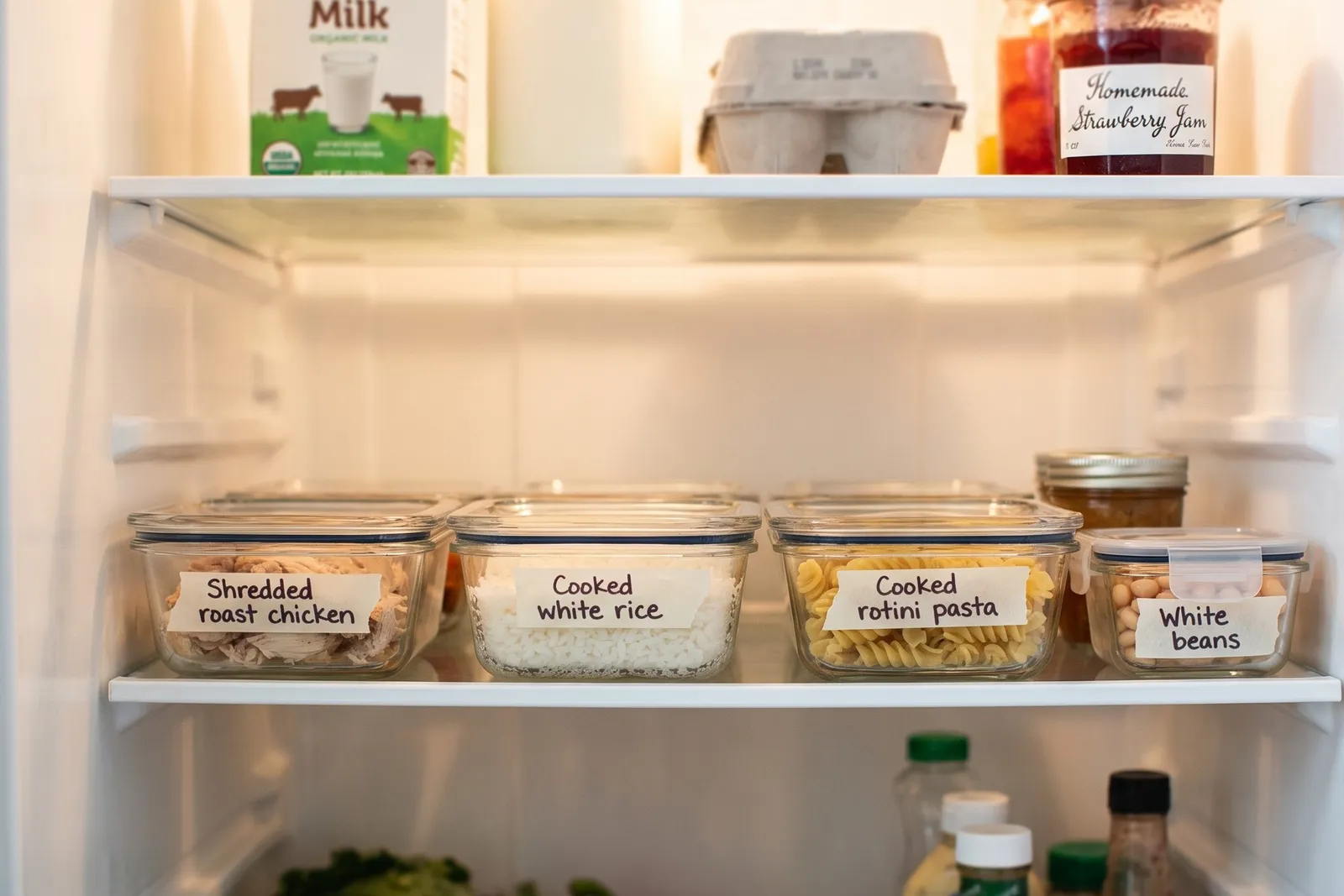
That container of leftover rice isn’t a leftover. It’s three cups of your next dinner. Most leftovers go wrong the same way. They go in the fridge with no plan, slide behind the milk, and come back out on Saturday as a question nobody wants to answer. You know the one: you lift the lid, you sniff, and you put the lid back on. Here’s the fix. Before the dishes are done, every leftover gets two things: a next use and a deadline.
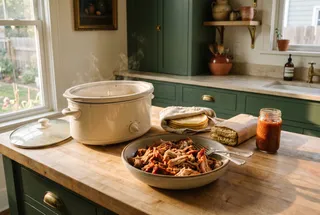 From No. 05Cook Once, Transform TwiceYou planned those leftovers. These are the ones nobody planned.
In No. 05 you learned how many days a cooked thing keeps. Now let’s spend those days on purpose. Back in No. 04 your lids started saying when food has to be gone. Today they get one more line: what it turns into. And when you build dinner from what needs using, the way No. 02 showed you, half the thinking’s already done.
The HearthIQ ruleEvery leftover gets a next use and a deadline.
A leftover with no plan is just waste that hasn’t happened yet. So nothing goes in the fridge without a name. It gets a container, a strip of tape and a plan. Then it gets eaten, which is the whole point.
Shop this
1 · Before the dishesPut it away with a plan.
Step 1: Pack it shallow
Split leftovers into shallow containers so they cool fast. Pull meat off the bone and slice big pieces first. Hot food can go straight into the fridge. You don’t need to let it cool on the counter first. (We know. Everybody’s mom did it.) The bones go in their own bag. They’re chain 7.
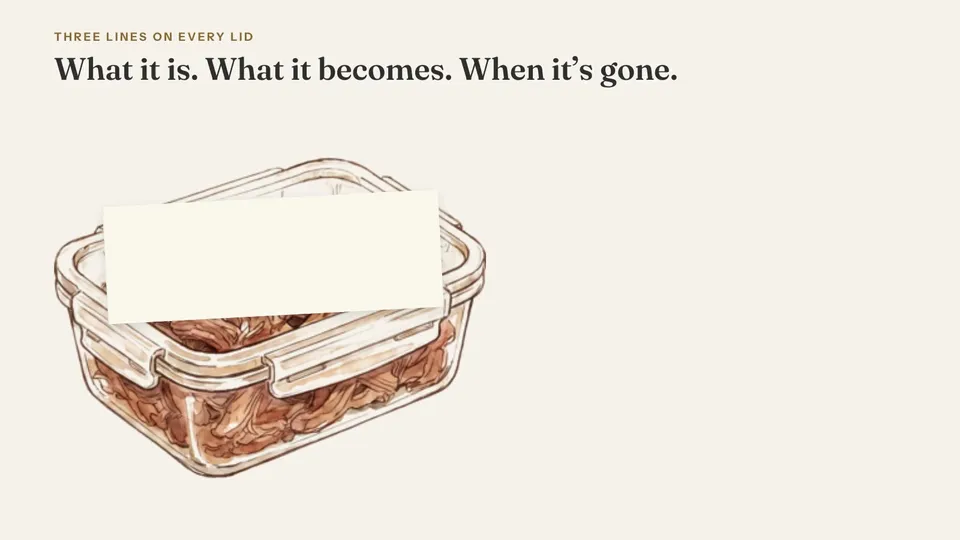
Step 2: Write what it is and when
On a strip of tape on the lid: the food and the day you cooked it.
Step 3: Give it a next use
Pick one dish from the chains below and write it on the second line. If nothing fits this week, be honest, skip to the last step and freeze it tonight.
Step 4: Count the days
Take the day you cooked it and add the days it keeps, from the list in section 2. Write that last day on the third line.
Step 5: Put it where you’ll see it
Labels facing out, on the eye-level fridge shelf from No. 04. It works just like the Use first bin in your freezer from No. 01: if it’s on that shelf, it’s tonight’s first option.
Step 6: On the last day, eat it or freeze it
If the next use hasn’t happened by the date on line three, it goes in the freezer that night. Lay it flat in a quart bag, the way No. 01 showed you, and copy the label over.
2 · How long it keepsCount the days before you plan.
Your fridge should sit at 40°F or colder and your freezer at 0°F. The fridge days are about safety, so stick to them. The freezer days are about taste: food kept at 0°F stays safe, but after this long it starts to dry out and lose flavor.
Cooked chicken, turkey or meat
Fridge 3 to 4 days. Freezer 2 to 6 months. The bones: use within 3 to 4 days, or freeze them.
Cooked rice
Fridge 4 to 6 days. Freezer 6 months. It keeps longer than the other cooked leftovers here, so it can wait its turn while the chicken goes first.
Cooked pasta
Fridge 3 to 5 days. Freezer 1 to 2 months.
Opened canned beans
Fridge 3 to 4 days, covered.
Bread
On the counter 3 to 5 days. Keep it out of the fridge, where it dries out and goes stale faster. Freeze it for up to 3 months.
Homemade stock
Fridge 3 to 4 days. Freezer 2 to 3 months.
What the chains make
Pasta salad: 3 to 4 days, and it doesn’t freeze well. White bean dip: 4 days. Croutons: up to a week in an airtight container.
3 · The chainsSeven leftovers, seven next uses.
Each chain is one leftover, what it becomes, and how. The amounts come from tested home recipes, and each one tells you how much it makes. When you warm up a leftover, heat it to 165°F all the way through. An instant-read thermometer (the kind you poke in and read in a few seconds) is the only way to know for sure.
Chain 1 · Roast chicken → quesadillasTuesday’s quesadillas, from Sunday’s chicken.
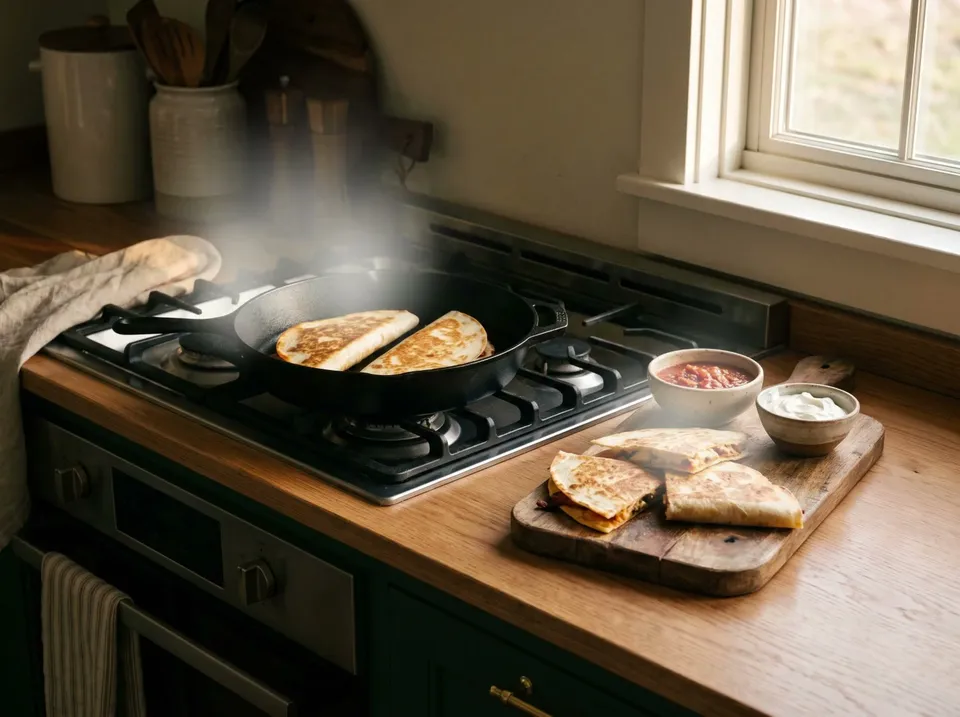
Makes 4. You need four 8-inch tortillas, ¾ cup shredded cheese, ½ cup beans (cooked, or canned and rinsed), ½ cup chopped vegetables (corn, peppers, onion, tomato, or the last of a tray of roasted ones) and about 1 cup of shredded chicken. The chicken is our addition to a classic vegetable quesadilla.
Step 1: Heat the chicken first
Warm it, covered, until it reaches 165°F. A quesadilla only spends a few minutes in the pan, so the filling should go in hot.
Step 2: Fill half of each tortilla
3 tablespoons cheese, 2 tablespoons beans, 2 tablespoons vegetables and a quarter of the chicken on one half. Fold the empty half over.
Step 3: Brown both sides · 4–6 min
Medium heat, a lightly greased skillet, about 2 to 3 minutes a side, until golden and the cheese melts. Top with salsa or whatever is already open.
Next in the chain: the carcass, which is just the bones left after carving. Bag it tonight, and it turns into stock before its 3 to 4 days are up (chain 7).
Shop this
Chain 2 · Cooked rice → stuffed peppersThree cups of rice fill eight pepper halves.
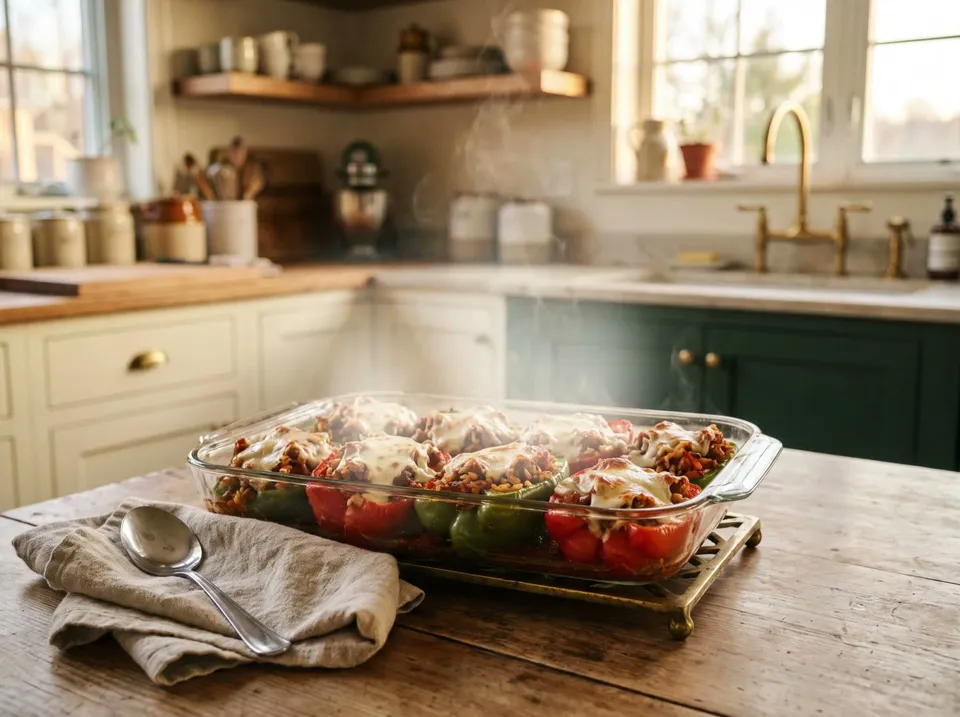
Makes 8 pepper halves. You need ½ pound ground sausage or beef, 1 chopped onion (about 1 cup), 1 teaspoon dried oregano, a 15-ounce can of spaghetti sauce, 3 cups cooked rice, 1 cup shredded mozzarella and 4 large bell peppers. No meat? Use 1 cup cooked beans instead.
Step 1: Brown the meat
Heat the oven to 350°F. Brown the meat with the onion until it reaches 160°F, the safe temperature for ground meat. Pour the fat into a bowl, let it harden in the fridge and spoon it into the trash, not down the drain.
Step 2: Mix the filling
Stir in the oregano, the sauce, the rice and ½ cup of the cheese.
Step 3: Fill and bake · 40 min
Cut the peppers in half lengthwise, scoop out the seeds and set them in a 9×13-inch dish. Mound the filling in. Cover with foil and bake 30 minutes, then uncover, add the rest of the cheese and bake 10 minutes more.
Cooking for fewer? Freeze the filling in three or four portions. Thaw one in the fridge, then bake it in two or three pepper halves within 3 to 4 days.
Shop this
Chain 3 · Taco meat → taco rice saladThe taco night that leaves meat behind.
Taco night always leaves a little meat in the pan, usually about one taco’s worth too much to throw out and not enough for another taco night. Turn it into a big salad bowl for lunch. Warm the leftover meat with cooked rice (a microwave pouch works) until it reaches 165°F. Stir in chopped tomatoes and a seeded, finely chopped jalapeño, and heat 2 to 3 minutes more. Spoon it over spinach or romaine and top with shredded cheese.
How much: the full recipe uses 1 pound of meat with 3 cups chopped tomatoes, 2 cups greens and 1 cup cheese, and serves 8. Scale to the meat you have: half a pound left over, half of everything else. Leftover corn, black beans, salsa and cilantro all belong on top.
Chain 4 · Day-old bread → French toast and croutonsStale bread works better.
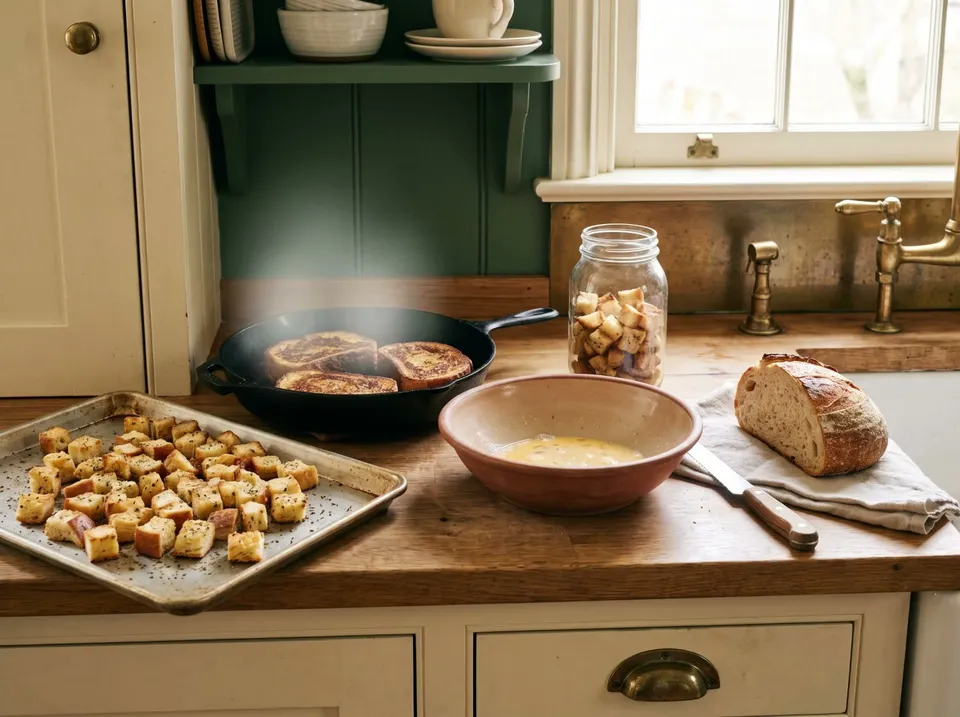
French toast, serves 4. Beat 4 eggs with 1 cup milk and ½ teaspoon cinnamon or nutmeg in a bowl wide enough to lay a slice in. Heat 1 tablespoon oil in a skillet over medium-high. Dip 8 slices of day-old bread one at a time, turning to coat both sides, and brown each side about 2 to 3 minutes. Serve with syrup, applesauce or sliced fruit.
Croutons, about 3 cups. The heels and odd slices: cut 4 slices into 1-inch cubes, toss with 1 tablespoon oil, then 1 teaspoon garlic powder and 1 teaspoon dried basil. Spread them on a greased baking sheet and bake at 350°F for 10 minutes. Stir, and bake up to 5 minutes more, until golden. Cool, and keep them airtight up to a week. Crush a bagful for seasoned breadcrumbs.
Bread is the one leftover you can pause. If you won’t get to it in 3 to 5 days, freeze the loaf, before it’s a science project.
Chain 5 · Cooked pasta → pasta saladFour cups of plain pasta, one cold lunch.
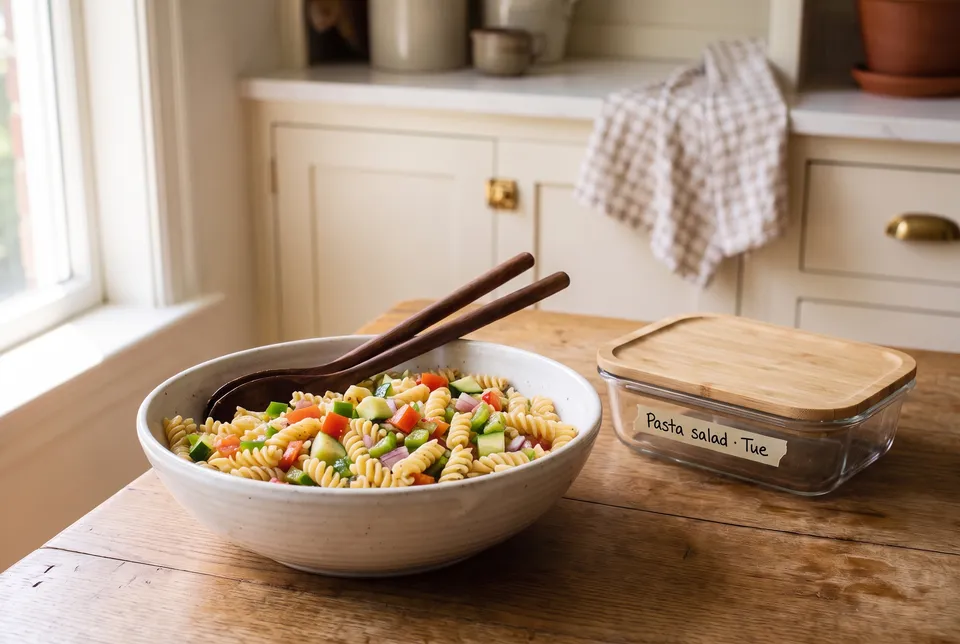
Serves 6. Toss 4 cups cooked pasta with 1 chopped cucumber, 1 chopped tomato, ½ chopped green pepper, ½ chopped red onion and ⅓ cup Italian dressing. Cover, chill, and toss again before serving. Leftover roasted vegetables can stand in for the fresh ones.
Mind the date: pasta salad doesn’t freeze well, so this is the end of the chain. Make only what you’ll eat by the date on the pasta’s lid.
Chain 6 · Half a can of beans → white bean dipThe half can that becomes Thursday’s lunch.
Makes about 1 cup. Blend a 15-ounce can of white beans, drained and rinsed (or 1½ cups cooked beans), with 2 tablespoons lemon juice, 2 tablespoons oil, 2 small cloves minced garlic and 1 teaspoon dried basil, parsley, oregano or rosemary. No blender? Mash it with a fork. Only half a can left? Halve everything.
It keeps 4 days covered in the fridge. Serve it with cut-up vegetables or crackers, or spread it inside a wrap with the last of the chicken. Same half can, now it looks like you planned it.
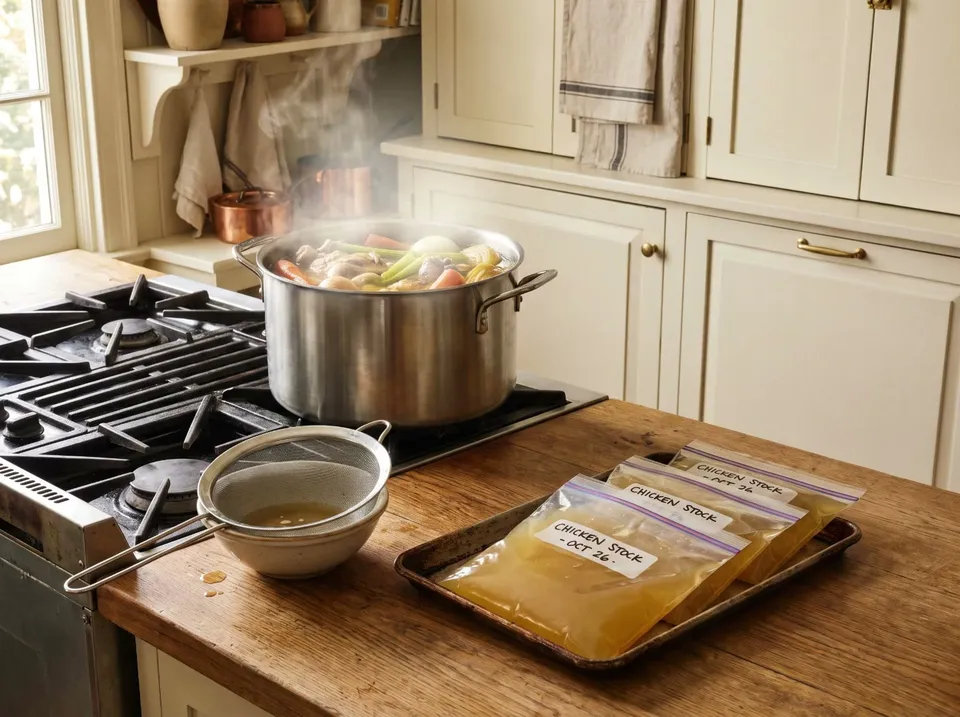
Chain 7 · Bones → stockThe last link: the carcass.
Step 1: Bag the bones tonight
Into the fridge within 2 hours of carving. Use them within 3 to 4 days, or freeze them for a stock day later.
Step 2: Simmer · 3+ hours
Put the bones in a large pot and cover them with water. Add carrot, celery and onion if you have them. Let it simmer gently for three hours or more.
Step 3: Strain and split
Strain out the bones and vegetables. Keep what you’ll use in the next 3 to 4 days in the fridge. Cool the rest quickly in shallow containers and freeze it right away, flat in quart bags.
Step 4: Boil it to reheat
Bring stock, soups and gravy to a full, rolling boil (big bubbles that keep going when you stir) when you warm them up.
Shop this
“Shop your fridge before you shop the store. Tonight’s dinner may already have a label on it.”
4 · The last dayEat it, freeze it, or let it go.
The date on line three is a little promise to yourself. On that night, one of four things happens. Here’s how to choose.
- F
Freeze it — Cooked chicken and meat, rice, pasta, stock, stuffed-pepper filling and bread all freeze. So do very ripe bananas: freeze them for 2 to 3 months for smoothies and baking.
- E
Eat it today — Pasta salad, chicken salad and hard-cooked eggs don’t freeze well. If their date is today, they are lunch.
- T
Thaw it the slow way — Thaw frozen leftovers in the fridge, then eat them within 3 to 4 days. Or warm them straight from frozen. Thawed something in cold water or the microwave? Heat it to 165°F before any of it goes back in the freezer.
- L
Let it go — Anything past its date, or anything that sat out longer than 2 hours (1 hour on a day over 90°F), goes in the trash. When in doubt, throw it out.
Thawed a big container and only need some? Take what you need and put the rest back in the freezer without heating it, as long as it thawed in the fridge. Warmed it all up? Any you didn’t eat can go back in the freezer once it has reached 165°F.
Quick referencePin this.
Sources: USDA FSIS, Leftovers and Food Safety · FoodSafety.gov, Cold Food Storage Chart · USDA FoodKeeper · Iowa State University Extension, Spend Smart. Eat Smart.: Vegetable Quesadillas, Stuffed Peppers, Tasty Taco Rice Salad and Giving New Life to Leftovers, French Toast, Croutons, Pasta Salad, White Bean Dip, Turkey Time: Now and Later and Extra Rice? · University of Illinois Extension, Leftovers · America’s Test Kitchen reviews of glass food storage and instant-read thermometers. Checked October 4, 2026. HearthIQ may earn a commission on product links.